
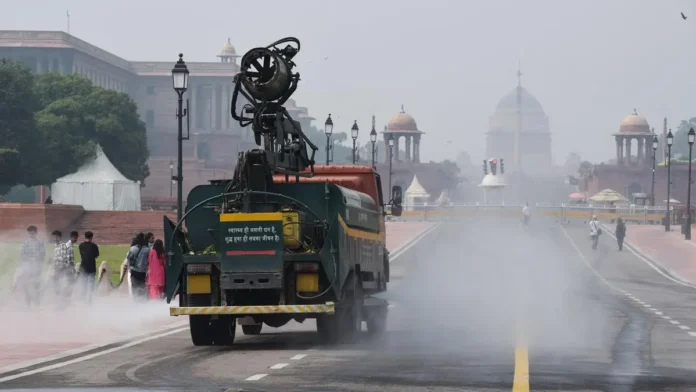
Delhi, the capital city of India, has been facing a major environmental crisis for quite some time now. The air quality in the city has been deteriorating at an alarming rate, causing serious health concerns for its residents. However, there is a glimmer of hope amidst this gloomy situation. According to the latest data released by the Central Pollution Control Board (CPCB), Delhi recorded an average Air Quality Index (AQI) of 306 at 9 pm on Sunday. This is a significant improvement from the previous days and is a positive sign for the city’s fight against air pollution.
The AQI is a measure of the level of pollutants present in the air. It ranges from 0 to 500, with higher values indicating higher levels of pollution. An AQI between 0-50 is considered good, 51-100 is satisfactory, 101-200 is moderate, 201-300 is poor, 301-400 is very poor, and 401-500 is severe. The average AQI of 306 recorded in Delhi on Sunday falls under the ‘very poor’ category, but it is still an improvement from the ‘severe’ levels that the city has been experiencing in the past few weeks.
The improvement in Delhi’s air quality can be attributed to various factors. One of the major reasons is the change in weather conditions. The city has been experiencing light rainfall and strong winds, which have helped in dispersing the pollutants in the air. The stubble burning in neighboring states, which is a major contributor to Delhi’s air pollution, has also reduced significantly in the past few days. The efforts of the Delhi government and various organizations to control pollution have also played a crucial role in this improvement.
The Delhi government has been taking several measures to combat air pollution in the city. The implementation of the Odd-Even scheme, where vehicles with odd and even number plates are allowed to ply on alternate days, has helped in reducing vehicular emissions. The government has also introduced the use of electric buses and has increased the number of public transport vehicles to encourage people to use public transport instead of private vehicles. The ban on the use of diesel generators and the closure of coal-based power plants have also contributed to the improvement in air quality.
Apart from the government, various organizations and individuals have also taken up the responsibility of fighting air pollution in Delhi. Many NGOs and citizen groups have been actively involved in creating awareness about the harmful effects of air pollution and have been organizing campaigns to encourage people to take necessary steps to reduce pollution. The citizens of Delhi have also shown great enthusiasm in adopting eco-friendly practices, such as carpooling, using public transport, and avoiding the use of firecrackers during festivals.
The improvement in Delhi’s air quality is a positive sign, but it is not the end of the battle against air pollution. The city still has a long way to go in achieving a clean and healthy environment for its residents. The government and citizens must continue their efforts to sustain this improvement and work towards achieving a better AQI in the future. It is crucial to understand that the fight against air pollution is not a one-time effort, but a continuous process that requires the collective effort of everyone.
The improvement in Delhi’s air quality is not only beneficial for the city but also for the entire country. Delhi is not the only city facing the issue of air pollution; many other cities in India are also struggling with it. The improvement in Delhi’s air quality sets an example for other cities to follow and shows that with determination and collective efforts, it is possible to combat air pollution.
In conclusion, the average AQI of 306 recorded in Delhi on Sunday is a positive development in the city’s fight against air pollution. It is a result of the combined efforts of the government, organizations, and citizens. However, this improvement must not lead to complacency, and we must continue to work towards achieving a cleaner and healthier environment for ourselves and future generations. Let us all join hands and make Delhi a pollution-free city.