
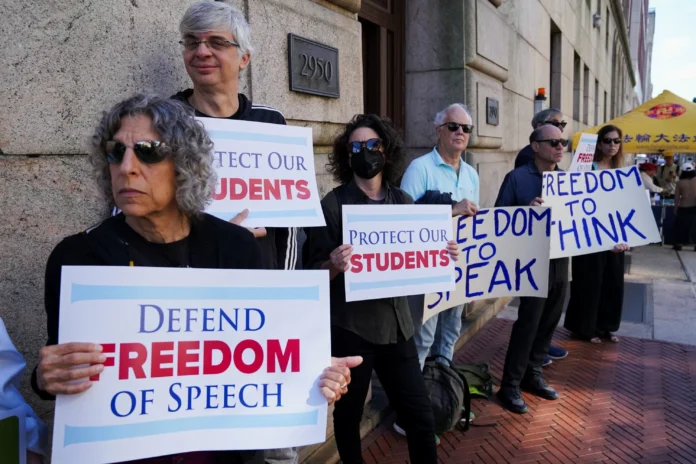
On Tuesday, a U.S. judge made a significant ruling against the Trump administration, stating that they had violated the Constitution by targeting foreign students and faculty who were engaged in pro-Palestinian advocacy. This ruling comes as a victory for many who have been fighting against the administration’s discriminatory policies towards those who support Palestinian rights.
The case was brought forward by the American Civil Liberties Union (ACLU) on behalf of the Middle Eastern Studies Association, the Arab-American Anti-Discrimination Committee, and several individual plaintiffs. The plaintiffs argued that the Trump administration’s visa revocation policies were deliberately targeting individuals based on their political beliefs, in violation of the First Amendment’s protection of free speech and expression.
In his ruling, Judge Edgardo Ramos stated that the administration’s actions were “unconstitutional and impermissible,” and that it was clear that they were targeting individuals based on their political views and beliefs. The judge also noted that the administration’s actions were causing harm to the affected individuals, their families, and the institutions they were associated with.
The ruling is a huge blow to the Trump administration’s efforts to silence and suppress pro-Palestinian advocacy on college campuses. In recent years, the administration has taken several measures to limit the activities of individuals and groups who support Palestinian rights, including attempts to redefine anti-Semitism to include criticism of Israel.
One of the most significant measures was the revocation of visas for students and faculty who were associated with the Boycott, Divestment, and Sanctions (BDS) movement, a global campaign that advocates for economic and political pressure on Israel to end its occupation of Palestinian territories. This move was widely seen as an attempt to stifle free speech and silence those who were critical of Israel’s actions.
The judge’s ruling is an important step in protecting the rights of individuals to express their political views without fear of retribution from the government. It also serves as a reminder that the U.S. Constitution guarantees the right to free speech and expression for all individuals, regardless of their beliefs or political affiliations.
In a statement following the ruling, the ACLU hailed the decision as a victory for the First Amendment and for those who have been unfairly targeted by the Trump administration’s discriminatory policies. They also emphasized that the ruling sets an important precedent for future cases involving the suppression of free speech.
The ruling is also a significant win for Palestinian rights activists and their allies who have been pushing back against the administration’s attempts to silence their voices. The BDS movement has faced numerous challenges in the United States, including attempts to criminalize their activities and smear them as anti-Semitic. This ruling is a clear indication that such tactics will not be tolerated and that individuals and groups have the right to advocate for Palestinian rights without facing consequences from the government.
It is also worth noting that the ruling comes at a time when the Trump administration has been heavily criticized for its biased approach to the Israeli-Palestinian conflict. Many have accused the administration of being one-sided in their support for Israel, while ignoring the rights and struggles of Palestinians. This ruling serves as a reminder that the U.S. government should uphold the principles of fairness and equality for all, regardless of their nationality or political beliefs.
In conclusion, the U.S. judge’s ruling against the Trump administration’s discriminatory policies towards foreign students and faculty who engage in pro-Palestinian advocacy is a significant victory for free speech and expression. It sends a strong message that the government cannot target individuals based on their political beliefs and that the Constitution protects the rights of all individuals, regardless of their views. It is a step towards upholding the values of democracy and justice, and we can only hope that it will serve as a precedent for future cases involving the protection of free speech.