
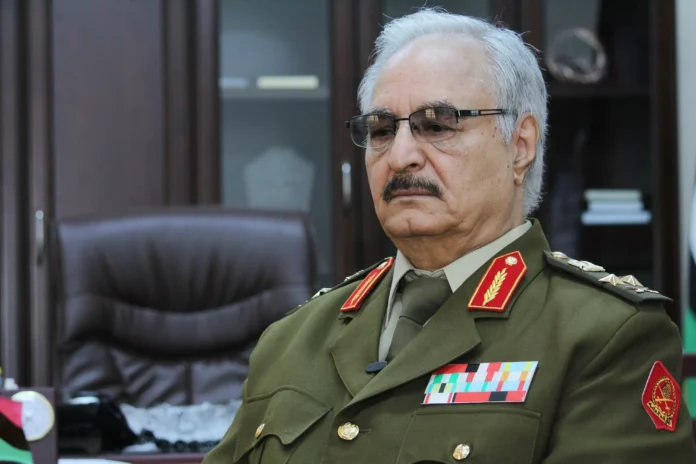
Libya’s Eastern Commander Khalifa Haftar to Visit Turkey, Signaling Possible Shift in Relations
Libya’s ongoing political turmoil has captured the attention of the international community, with various factions vying for control of the country. Amidst this chaos, there have been recent reports that eastern commander Khalifa Haftar is planning to visit Turkey later this month, potentially signaling a significant shift in relations between the two nations.
According to Middle East Eye (MEE), Turkish, Libyan, and Egyptian sources have confirmed that Haftar is set to visit Turkey, although no official statement has been released. This news comes as a surprise, as Haftar has been a fierce opponent of the Turkish-backed Government of National Accord (GNA) in Tripoli and has received support from Turkey’s regional rival, Egypt.
Haftar, who controls a significant portion of eastern Libya, has been engaged in a power struggle with the GNA, which is recognized by the United Nations as the legitimate government of Libya. The two sides have been locked in a conflict for years, with both receiving support from various international actors. Turkey, in particular, has been a staunch supporter of the GNA, supplying military aid and sending troops to help defend against Haftar’s offensive.
However, Haftar’s planned visit to Turkey has raised eyebrows and led to speculation about a potential change in his stance towards the country. Some experts believe that Haftar’s visit could be a sign of his willingness to negotiate with the GNA and potentially broker a peace deal.
The potential visit is also significant in light of recent developments in the region, including the recent ceasefire agreement between the GNA and Haftar’s forces. The agreement, brokered by Turkey and Russia, has been holding so far, raising hopes for a lasting peace in the war-torn country.
Moreover, the visit could also mark a possible shift in Haftar’s relationship with Turkey’s regional rivals, Egypt and the United Arab Emirates (UAE). Both countries have been providing military support to Haftar, but their involvement in Libya has caused tension with Turkey, leading to a proxy conflict between the two sides.
However, recent reports suggest that both Egypt and the UAE might be considering a reevaluation of their support for Haftar in light of the ongoing ceasefire and Turkey’s growing influence in the region. This potential shift in alliances could have significant implications for the future of the conflict in Libya.
Additionally, Haftar’s visit could also signal a desire for economic cooperation between Turkey and Libya. With Turkey’s strong economic presence in the region, Haftar may see the potential for economic benefits from closer ties with Ankara. This could also help stabilize the Libyan economy, which has been struggling amidst the ongoing political turmoil.
For Turkey, Haftar’s potential visit signifies the success of its diplomatic efforts in the region. The country’s involvement in Libya has been met with criticism from some international actors, but this potential visit could serve as a sign of Turkey’s growing influence and diplomatic reach.
Moreover, closer ties with Haftar could also help Turkey’s efforts to combat terrorism in the region. Haftar’s forces have been active in fighting against extremist groups, which pose a threat not only to Libya but also to Turkey’s security.
In conclusion, the potential visit of Khalifa Haftar to Turkey holds significant implications for the ongoing conflict in Libya and the region as a whole. While it remains to be seen if the visit will indeed take place, its mere possibility is a sign of potential progress towards peace and stability in Libya. It also reflects Turkey’s increasing role in the region, both diplomatically and economically. Let us hope that this visit will lead to positive developments and bring an end to the suffering of the Libyan people.