
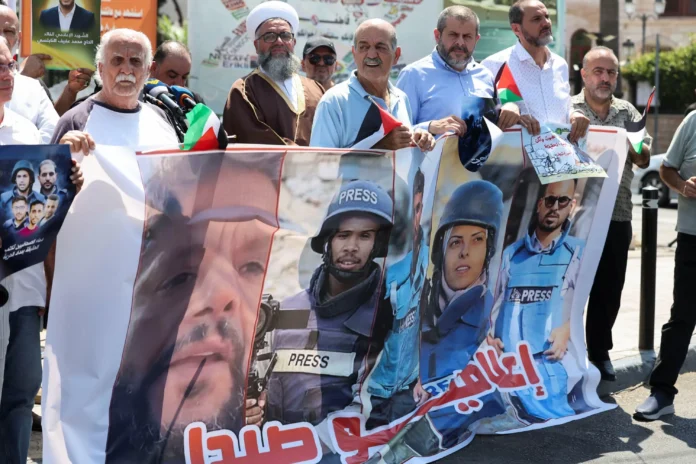
More than 250 media outlets across 70 countries united in solidarity on Monday to protest Israel’s recent killing of journalists in the Gaza Strip. In a powerful display of support for press freedom, these outlets blacked out their front pages, websites, and broadcasts to bring attention to the dangers faced by journalists in conflict zones.
The protest was sparked by the recent deaths of Palestinian journalist Yasser Murtaja and photojournalist Ahmed Abu Hussein, who were both killed while covering the ongoing protests in Gaza. Murtaja, a 30-year-old photographer, was wearing a vest clearly marked with the word “PRESS” when he was shot by Israeli forces. Abu Hussein, 25, was also wearing a press vest when he was fatally shot in the stomach while documenting the protests.
These tragic deaths have once again highlighted the risks that journalists face while reporting from conflict zones. According to the Committee to Protect Journalists, at least 15 journalists have been killed in Gaza since 1992, with most of the deaths occurring in the past decade. The dangers faced by journalists in Gaza are not limited to physical violence, but also include censorship, harassment, and restrictions on movement and access to information.
In response to these threats, media outlets from around the world have come together to show their support for press freedom and to demand justice for the slain journalists. The blackout, organized by the International Federation of Journalists (IFJ), was a powerful way to draw attention to the issue and to send a message to governments and authorities that the safety of journalists must be a top priority.
The blackout was not limited to traditional media outlets, but also included social media platforms such as Twitter and Facebook, where many journalists changed their profile pictures to a black screen with the words “Journalism is not a crime” written in white. This social media campaign helped to spread the message even further and garnered support from individuals and organizations around the world.
The IFJ also called on governments to take action to protect journalists and to hold those responsible for their deaths accountable. In a statement, IFJ President Philippe Leruth said, “We demand that governments take concrete steps to ensure the safety of journalists and end the culture of impunity that allows these attacks to continue.”
The blackout received widespread support from media organizations, with major outlets such as The New York Times, The Guardian, and Al Jazeera participating. In Israel, the country’s largest newspaper, Haaretz, also joined the protest by publishing a blank front page with the headline “When the press is silenced, democracy dies.”
The blackout was not only a show of solidarity, but also a reminder of the important role that journalists play in a functioning democracy. They are the ones who bring us the news, shine a light on injustices, and hold those in power accountable. When journalists are silenced, so is the truth.
The protest also highlighted the need for greater protection for journalists in conflict zones. The IFJ has called for the implementation of the UN Security Council Resolution 2222, which calls for the protection of journalists in conflict situations. The resolution also calls on governments to investigate attacks on journalists and to bring those responsible to justice.
It is crucial that governments and authorities take the necessary steps to ensure the safety of journalists, not just in Gaza, but around the world. Attacks on journalists not only endanger the lives of those reporting, but also threaten the free flow of information and the public’s right to know.
As media outlets continue to face challenges and attacks, it is important for us to stand in solidarity with journalists and to defend press freedom. The blackout on Monday was a powerful reminder of the importance of a free and independent press, and the need for governments to protect the safety of journalists. Let us not forget the sacrifices that journalists make in order to bring us the news, and let us continue to demand justice for those who have lost their lives in pursuit of the truth.