
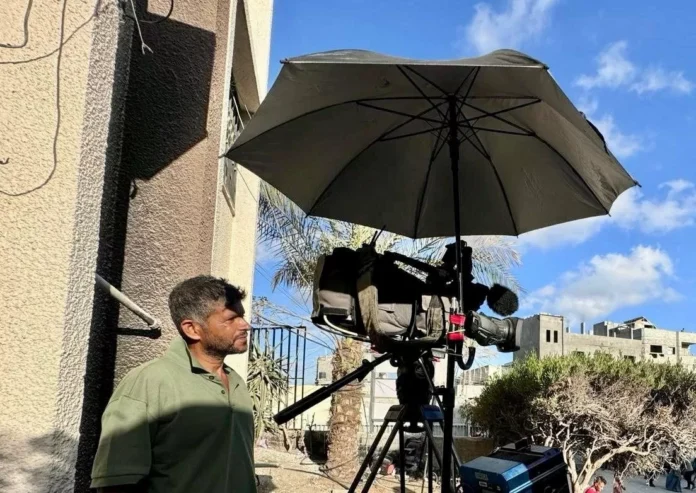
Canadian photojournalist Valerie Zink has made headlines after announcing her resignation from Reuters, one of the world’s leading news agencies. After eight years of working for the agency, Zink has decided to part ways and has publicly denounced Reuters’ coverage of the ongoing conflict in Gaza. In a powerful statement, she has accused the agency of betraying journalists and enabling Israel’s actions in the region.
Zink’s decision to leave Reuters has sparked a much-needed conversation about the role of media in reporting on conflicts and the ethical responsibilities of news agencies. Her bold move has also shed light on the challenges faced by journalists in covering sensitive and controversial issues.
In her statement, Zink expressed her disappointment with Reuters’ coverage of the Gaza conflict, stating that it was a betrayal of journalists who strive to report the truth. She believes that the agency’s biased reporting has not only harmed the credibility of Reuters but has also contributed to the ongoing violence in the region.
Zink’s concerns are not unfounded. The conflict in Gaza has been ongoing for decades, and the media’s portrayal of it has often been one-sided. As a photojournalist, Zink has witnessed the impact of this biased reporting firsthand. She has seen how the media’s portrayal of the conflict has perpetuated stereotypes and fueled hatred and violence.
In her statement, Zink also accused Reuters of enabling Israel’s actions in Gaza. She believes that the agency’s coverage has downplayed the suffering of the Palestinian people and has given a platform to Israel’s narrative. As a journalist, Zink believes in the power of media to hold those in power accountable and to give a voice to the voiceless. However, she feels that Reuters has failed in its duty to do so.
Zink’s resignation has sparked a much-needed conversation about the ethical responsibilities of news agencies in reporting on conflicts. As journalists, we have a duty to report the truth and to give a voice to all sides of the story. However, in the case of the Gaza conflict, this duty seems to have been overshadowed by political agendas and biases.
Zink’s decision to leave Reuters was not an easy one, but it was a necessary one. She has shown immense courage and integrity in standing up for her principles and speaking out against the injustices she has witnessed. Her actions serve as a reminder to all journalists that our responsibility is to the truth, not to any political or corporate interests.
The conflict in Gaza is a complex and sensitive issue, and it is the responsibility of the media to report on it with sensitivity and objectivity. As journalists, we must strive to give a voice to all sides of the story and to present the facts without bias. It is only through honest and ethical reporting that we can hope to bring about change and promote understanding and peace.
Zink’s resignation from Reuters has also brought to light the challenges faced by journalists in covering conflicts. Journalists put their lives at risk every day to bring us the news, and they often face immense pressure and censorship from various sources. Zink’s resignation is a reminder of the sacrifices made by journalists in pursuit of the truth.
In conclusion, Valerie Zink’s resignation from Reuters has sparked an important conversation about the role of media in reporting on conflicts and the ethical responsibilities of news agencies. Her bold move has shown that as journalists, we must stand up for our principles and not be afraid to speak out against injustices. Zink’s actions serve as a reminder that the truth must always be our top priority, and we must never let political or corporate interests cloud our reporting.