
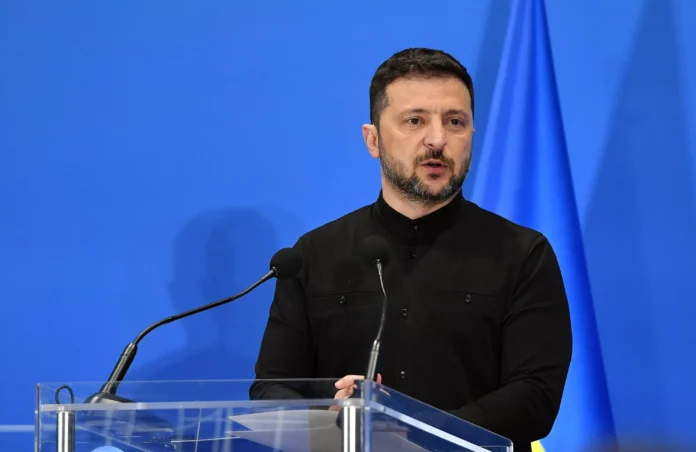
Ukrainian President Volodymyr Zelenskyy has expressed hope for a potential cease-fire with Russia after the recent visit of U.S. special envoy Steve Witkoff to Moscow. In a press conference on Wednesday, the Ukrainian President stated that Russia seemed more receptive to the idea of a truce, potentially signaling a positive turn in the ongoing conflict between the two nations.
President Zelenskyy said, “It seems that Russia is more open to a cease-fire than before.” This statement came after Witkoff’s discussions with Russian officials, including Russian Foreign Minister Sergey Lavrov. The envoy’s visit was a part of the United States’ effort to mediate the situation in eastern Ukraine, where tensions have been high since Russia’s annexation of Crimea in 2014.
The Ukrainian President’s statement is a glimmer of hope in the otherwise turbulent relations between the two neighboring countries. For years, Ukraine has been at the receiving end of Russia’s aggression, with the annexation of Crimea and its support for separatist rebels in eastern Ukraine. However, with the new U.S. administration assuming office earlier this year, there has been a renewed effort to find a peaceful resolution to the conflict.
The visit of U.S. special envoy Steve Witkoff to Moscow signals the United States’ commitment to finding a diplomatic solution to the crisis. It is seen as a significant step towards easing tensions in the region, and President Zelenskyy’s statement further strengthens this belief.
Despite the ongoing conflict, President Zelenskyy has remained adamant about finding a peaceful resolution. He has repeatedly called for a dialogue with Russia and emphasized the need for a cease-fire to end the bloodshed in eastern Ukraine. The Ukrainian President’s efforts have been widely appreciated by the international community, and his commitment to finding a solution through diplomacy has earned him praise.
The recent development of Russia’s willingness to consider a cease-fire comes as a surprise, given the country’s previous stance on the matter. Russia has been accused of fueling the conflict in eastern Ukraine by providing weapons and support to separatist rebels. However, with the recent visit of the U.S. special envoy, there seems to be a shift in Russia’s position.
The potential for a cease-fire is a significant development that can bring relief to the people of Ukraine, who have suffered immensely due to the ongoing conflict. The cease-fire would provide a much-needed respite, especially for those living in the conflict zone, who have borne the brunt of the violence. It would also allow for humanitarian aid to reach those in need, who have been affected by the conflict.
The Ukrainian President’s statement has sparked hope among the people of Ukraine, who have been longing for peace and stability in the region. It is a testament to President Zelenskyy’s perseverance and dedication towards finding a peaceful solution to the conflict. His efforts, along with the support of the international community, have brought the two nations closer to the possibility of a cease-fire.
While President Zelenskyy’s statement is a positive development, it is crucial to proceed with caution. It is essential to ensure that Russia follows through with its apparent willingness to consider a cease-fire and take concrete steps towards a peaceful solution. The world will be watching closely, and it is vital for both sides to maintain a constructive approach to achieve a lasting resolution.
In conclusion, President Zelenskyy’s statement about Russia’s openness to a cease-fire is a significant step towards finding a solution to the conflict in eastern Ukraine. It is a ray of hope that has sparked optimism among the Ukrainian people and the international community. The United States’ efforts and President Zelenskyy’s unwavering commitment to finding a peaceful resolution have brought the two nations closer to ending the ongoing bloodshed. As the world awaits further developments, let us hope that diplomacy and dialogue will prevail and bring peace to the region.