
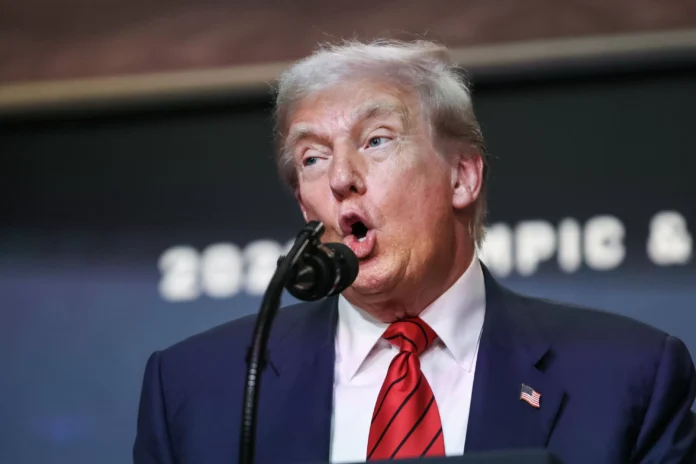
On Tuesday, U.S. President Donald Trump made headlines once again with his ambiguous stance on the Israeli-Palestinian conflict. In a press conference, he declined to take a clear position on whether Israel should fully occupy Gaza, a long-standing issue that has plagued the region for decades. Instead, he emphasized his administration’s focus on economic growth and peace negotiations in the Middle East.
During the press conference, President Trump was asked about the recent escalation of violence between Israel and Gaza, which resulted in over 130 Palestinian deaths and four Israeli fatalities. In response, Trump stated, “I don’t want to get involved in that, I think it’s a very tough situation.” He then added, “I’m just going to let that play out, see what happens.”
This lack of a clear position on the issue has drawn criticism from both sides of the conflict. Israeli Prime Minister Benjamin Netanyahu, a close ally of Trump, has long pushed for a full Israeli occupation of Gaza. On the other hand, Palestinian leaders have called for an end to the Israeli blockade and control over Gaza, which has been in place since 2007.
Despite the pressure from both sides, Trump’s stance on the issue is not surprising. Throughout his presidency, he has taken a more hands-off approach to the conflict, leaving the negotiation and resolution of the issue to the parties directly involved. However, his statements have also raised concerns about the U.S.’s role as a mediator and the effectiveness of the peace process.
The conflict between Israel and Palestine has been ongoing for over 70 years, with no clear resolution in sight. Previous U.S. administrations have attempted to broker a peace deal, but all have been unsuccessful. The Trump administration’s approach to the conflict has been vastly different, with a focus on improving the economic conditions in the region as a means to promote peace.
In June, Trump’s son-in-law and senior adviser, Jared Kushner, unveiled the economic portion of the administration’s Middle East peace plan. The plan, titled “Peace to Prosperity,” aims to invest $50 billion in the Palestinian economy and create over one million jobs in the region. However, the plan has been met with skepticism and criticism from both Israeli and Palestinian leaders, who argue that economic growth cannot be achieved without a political solution.
In his press conference, Trump reiterated his belief that economic growth is the key to achieving peace in the Middle East. He stated, “We’re going to be helping a lot with respect to the economy. I think ultimately that has a very good chance of success.”
While the administration’s focus on economic growth may be a step in the right direction, it is important to acknowledge that it alone cannot solve the deep-rooted issues that have contributed to the ongoing conflict. A political solution must also be pursued to address issues such as territorial disputes, security, and the rights of Palestinian refugees.
Trump’s lack of a clear position on the issue may be frustrating for some, but it also highlights the complexity of the conflict and the importance of finding a balanced and lasting solution. It is clear that there are no easy answers, but the U.S. must continue to play a role in promoting dialogue and working towards a peaceful resolution.
In the meantime, the violence in Gaza continues, and innocent lives continue to be lost. It is imperative that all parties involved prioritize the safety and well-being of their citizens and work towards de-escalation and a lasting peace.
As the leader of the free world, President Trump has a responsibility to take a more decisive stance on this critical issue. While his administration’s focus on economic growth is commendable, it must be accompanied by a commitment to promoting peace and stability in the region. Only then can we hope to see an end to the suffering and bloodshed in Gaza and the Middle East as a whole.