
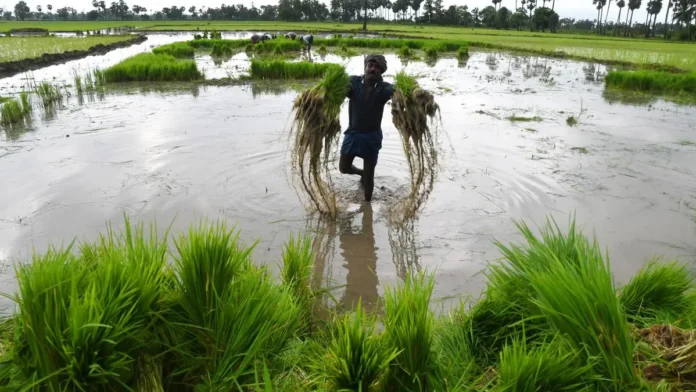
In a positive turn of events, the acreage for paddy, moong, and maize has seen a significant increase, while the coverage for cotton and soybeans has slightly decreased. This news comes as a ray of hope for the agricultural sector, which has been facing numerous challenges in recent times.
According to the latest data released by the Ministry of Agriculture, the acreage for paddy has increased by 10%, while the acreage for moong and maize has seen a remarkable rise of 25% and 30% respectively. This increase in acreage can be attributed to the favorable weather conditions and the government’s efforts to promote these crops.
Paddy, also known as rice, is one of the staple crops of our country and is grown extensively in various regions. The increase in acreage for paddy is a positive sign for the farmers as it will not only meet the domestic demand but also contribute to the export market. The government’s initiatives such as providing high-quality seeds, fertilizers, and irrigation facilities have played a crucial role in this increase.
Similarly, the acreage for moong and maize has also seen a significant rise. Moong, also known as green gram, is a protein-rich crop and is in high demand in the international market. The increase in acreage for moong will not only boost the income of the farmers but also reduce our dependence on imports. Maize, on the other hand, is a versatile crop and is used for both human consumption and animal feed. The increase in acreage for maize will not only cater to the domestic demand but also contribute to the export market.
However, the coverage for cotton and soybeans has slightly decreased. Cotton, which is known as the ‘white gold’ of our country, has seen a decrease in coverage by 5%. This can be attributed to the decrease in demand for cotton in the international market. The government is taking necessary steps to revive the cotton industry and increase its coverage in the upcoming seasons. Similarly, the coverage for soybeans has also decreased by 3%. Soybeans, which are used for various purposes such as cooking oil, animal feed, and biofuel, have seen a decrease in demand due to the availability of cheaper alternatives in the market.
The increase in acreage for paddy, moong, and maize is a positive sign for the agricultural sector, which has been facing numerous challenges such as unpredictable weather conditions, low prices, and lack of modern technology. This increase will not only boost the income of the farmers but also contribute to the overall growth of the economy. The government’s efforts to promote these crops through various schemes and initiatives have yielded positive results, and it is expected to continue in the future.
Moreover, the increase in acreage for these crops will also have a positive impact on the employment sector. With more land being utilized for cultivation, there will be a demand for labor, which will provide employment opportunities for the rural population. This will not only improve their standard of living but also reduce the migration of people from rural to urban areas.
In conclusion, the increase in acreage for paddy, moong, and maize is a positive development for the agricultural sector. It is a result of the government’s efforts to promote these crops and the favorable weather conditions. However, the decrease in coverage for cotton and soybeans is a cause for concern, and the government must take necessary steps to revive these industries. With the right policies and initiatives, the agricultural sector can continue to thrive and contribute to the growth of our nation.