
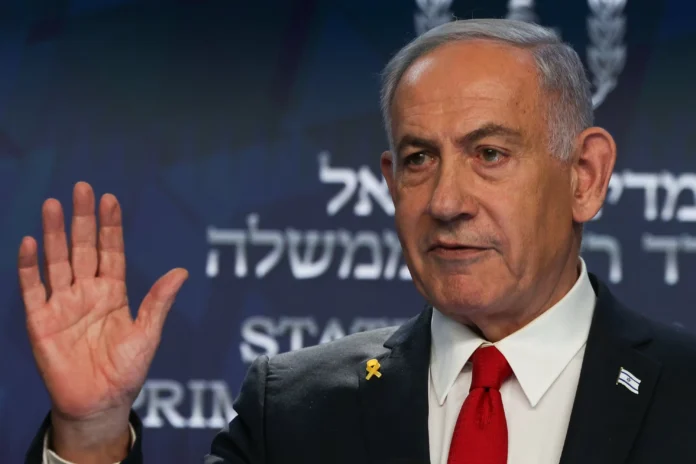
Israeli Prime Minister Benjamin Netanyahu has once again stirred up controversy with his recent comments on the ongoing conflict with Iran. On Monday, he suggested that assassinating Iran’s Supreme Leader Ali Khamenei could potentially bring an end to the conflict between the two nations. This statement has sparked intense debate and raised concerns about the potential consequences of such a drastic action.
Speaking at a press conference, Netanyahu stated, “I’m not advocating for it, but I’m not ruling it out either.” He went on to say that the assassination of Khamenei could potentially lead to a change in Iran’s behavior and ultimately bring an end to the ongoing tensions between the two countries.
This statement has been met with both support and criticism. Some have praised Netanyahu for his bold and uncompromising stance against Iran, while others have condemned his suggestion as reckless and dangerous. However, regardless of one’s stance on the matter, it is crucial to carefully consider the potential implications of such a drastic action.
The conflict between Israel and Iran has been ongoing for decades, with both sides engaging in hostile rhetoric and actions. The recent assassination of Iranian General Qasem Soleimani by the United States has only escalated tensions and raised fears of a potential all-out war. In this volatile climate, Netanyahu’s suggestion of assassinating Khamenei could have severe consequences.
First and foremost, the assassination of a country’s leader is a violation of international law and could lead to severe repercussions. It could also potentially spark a full-scale war between Israel and Iran, with devastating consequences for both nations and the entire region. Furthermore, it could also lead to a power vacuum in Iran, which could result in further instability and chaos.
Moreover, the assassination of Khamenei would not guarantee an end to the conflict. It could, in fact, have the opposite effect and further escalate tensions. Iran’s government and military are deeply entrenched and have a strong support base, which could retaliate with even more aggression. It could also lead to an increase in terrorist activities and attacks, not just in the region but also globally.
Furthermore, such a drastic action could also have severe repercussions for Israel. It could potentially isolate the country on the international stage and damage its relationships with other nations. It could also lead to an increase in anti-Israel sentiment and further fuel the conflict with Palestine.
It is essential to remember that the conflict between Israel and Iran is not just a bilateral issue. It has far-reaching implications for the entire region and the world. The repercussions of an assassination could have a ripple effect and destabilize the already fragile Middle East.
Instead of advocating for violence, it is crucial for leaders to seek diplomatic solutions to conflicts. It is only through open communication and dialogue that lasting peace can be achieved. The international community must also play a role in promoting peace and de-escalating tensions between Israel and Iran.
In conclusion, Prime Minister Netanyahu’s suggestion of assassinating Iran’s Supreme Leader Ali Khamenei is a dangerous and reckless proposition. It could have severe consequences for both nations and the entire region. Instead of advocating for violence, leaders must work towards finding peaceful solutions to conflicts. It is only through cooperation and understanding that lasting peace can be achieved. Let us hope that cooler heads prevail, and the ongoing tensions between Israel and Iran can be resolved through peaceful means.