
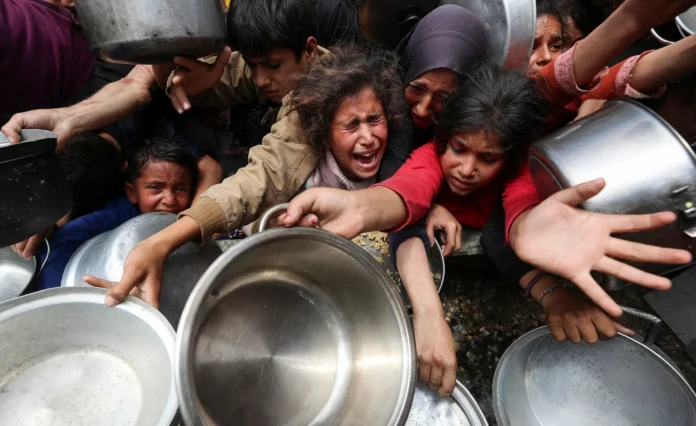
The United Nations Security Council met on Tuesday to discuss Israel’s reported plan to use third-party contractors to deliver humanitarian aid to the people of Gaza. While Israel has defended this decision, the majority of the Council members rejected it, citing concerns for the well-being of the Palestinians living in the besieged Gaza strip.
The U.S., which holds veto power in the Security Council, expressed full support for Israel’s plan. However, the rest of the members, including France, Russia, and the United Kingdom, have raised strong objections and urged Israel to reconsider its approach.
Gaza has been under Israeli blockade since 2007, which severely restricts the flow of goods and humanitarian aid into the territory. This has resulted in a dire humanitarian situation, with over half of the population being dependent on aid for survival.
In light of this situation, Israel’s plan to channel humanitarian aid through third-party contractors is being seen as a way to further tighten its grip on Gaza and weaken the already vulnerable population. According to reports, Israel intends to use these contractors to oversee the delivery of aid and determine which goods are allowed into Gaza, effectively giving them control over the flow of essential resources.
However, this move has been met with widespread criticism from the international community. As Ambassador Zhang Jun of China, one of the non-permanent members of the Security Council, stated, “This will only add to the suffering of the Palestinian people and will not help ease tensions in the region. We urge Israel to reconsider this decision and allow for the free flow of aid into Gaza.”
The situation in Gaza is a matter of grave concern for the entire international community, and the U.N. Security Council plays a critical role in addressing these issues. Therefore, it is disheartening to see the U.S. stand by Israel’s plan, ignoring the concerns raised by the majority of the Council.
It is imperative that humanitarian aid is delivered directly to Gaza, without any restrictions or interference from third-party contractors. This will not only alleviate the suffering of the Palestinian people but also help to build trust and stability in the region.
Furthermore, the Security Council must hold Israel accountable for its actions and demand that it lifts the blockade on Gaza. It is the legal and moral responsibility of the Security Council to ensure the protection and well-being of all civilians, regardless of their nationality or political affiliation.
In the face of these challenges, it is heartening to see the majority of the Security Council members taking a strong stance against Israel’s plan. This sends a clear message that the international community stands united in its support for the people of Gaza and their right to access vital humanitarian aid.
In conclusion, it is hoped that Israel will listen to the concerns of the international community and reconsider its approach towards delivering aid to Gaza. The U.N. Security Council must continue to work towards finding a sustainable and long-term solution to the humanitarian crisis in Gaza, and the support of all its members is crucial in achieving this goal. It is only through collaboration and cooperation that we can bring about meaningful change and improve the lives of those in need.