
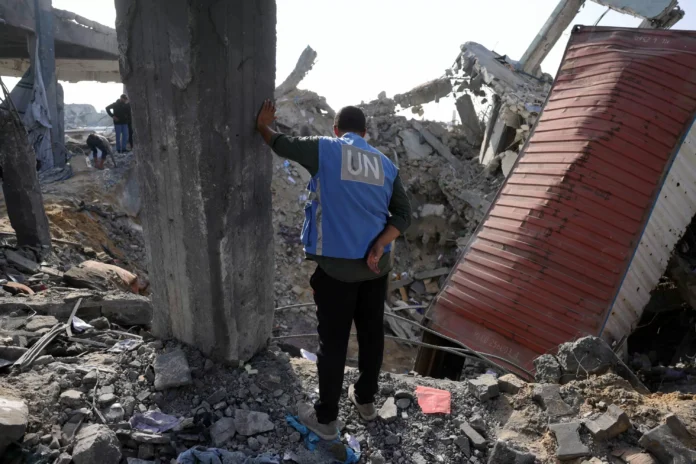
The United Nations Relief and Works Agency for Palestinian Refugees (UNRWA) has issued a grave warning regarding the ongoing blockade imposed by Israel on the Gaza Strip. In a statement released on Sunday, the agency stated that this blockade is causing “irreparable harm” to the lives of countless Palestinians. This situation cannot continue any longer, and it is time for the international community to take action and put an end to this suffering.
The Gaza Strip, a small coastal enclave located between Israel and Egypt, has been under a blockade since 2007. This blockade restricts the movement of people, goods, and services in and out of the territory, effectively trapping its 2 million inhabitants. The United Nations and various humanitarian organizations have repeatedly called for the lifting of this blockade, as it has caused a humanitarian crisis in Gaza. However, despite these pleas, the blockade continues, and its devastating effects on the lives of Palestinians cannot be ignored.
The UNRWA, which provides essential services to Palestinian refugees, has been on the ground in Gaza for decades and has witnessed firsthand the impact of this blockade. In its statement, the agency highlighted the dire consequences of the blockade on the health, education, and livelihoods of Palestinians. The blockade has severely restricted the entry of vital goods, such as medical supplies, into Gaza, resulting in a shortage of essential medicines and equipment. This has had a devastating impact on the health of Palestinians, especially those with chronic illnesses. In addition, the blockade has also severely limited the movement of people, making it difficult for Palestinians to access specialized medical care outside of Gaza.
The educational system in Gaza has also been greatly affected by the blockade. The UNRWA has reported that over 8,000 students in Gaza are unable to attend school due to the blockade. This has not only disrupted their education but has also left them vulnerable to exploitation and abuse. The agency has also stated that the blockade has severely impacted the economy in Gaza, leaving over 80% of the population dependent on humanitarian assistance. This has resulted in widespread poverty and unemployment, making life increasingly difficult for Palestinians, especially for young people who are struggling to find work and provide for their families.
The UNRWA’s warning comes at a time when the Gaza Strip is facing multiple crises, including the COVID-19 pandemic and the recent Israeli military offensive in May, which caused significant damage to infrastructure and displaced thousands of Palestinians. The agency has emphasized that the blockade has only exacerbated these crises, making it challenging to respond effectively and provide much-needed aid to those affected.
It is crucial to note that the blockade is not only a violation of human rights but also a violation of international humanitarian law. The Fourth Geneva Convention prohibits collective punishment, and the blockade of the Gaza Strip is a clear violation of this principle. The international community must hold Israel accountable for its actions and take immediate steps to lift the blockade. It is the responsibility of the international community to protect the rights and well-being of the Palestinian people and ensure that they are not subjected to further harm and suffering.
In conclusion, the UNRWA’s warning serves as a wake-up call to the international community. The blockade imposed by Israel on the Gaza Strip is causing immense suffering and must be lifted immediately. The lives and well-being of Palestinians cannot be put at risk any longer. The international community must work towards finding a long-term solution to the conflict and address the root causes of this crisis. It is time to put an end to the blockade and pave the way for a better future for the people of Gaza. As the UNRWA rightfully stated, “the time to act is now before it is too late.”