
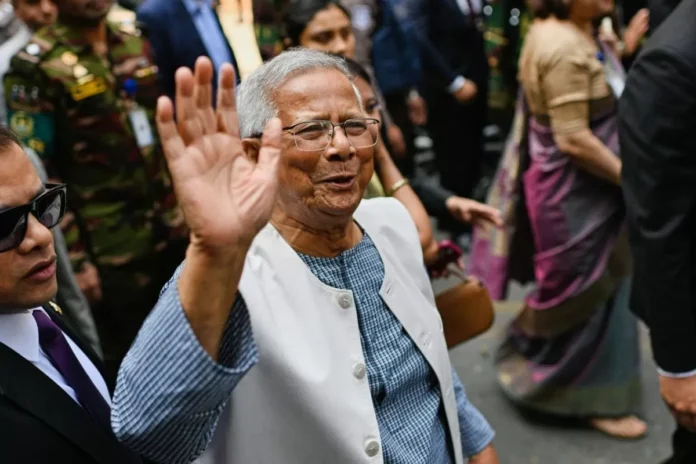
Muhammad Yunus’s journey has been nothing short of extraordinary. A visionary leader and a pioneer of the concept of microfinance, he has gained global recognition for his innovative approach to poverty alleviation. However, his journey has not been without its share of ups and downs, making it truly “unprecedented” in every sense of the word.
Born in 1940 in Chittagong, a port city in Bangladesh, Yunus grew up in a middle-class family and received his education from some of the best institutions in the country. After completing his studies in economics, he pursued a career in academia, eventually becoming a professor at the prestigious Chittagong University.
But it was his experience working with impoverished communities in rural Bangladesh that sparked his interest in finding a solution to the pervasive problem of poverty. Yunus saw firsthand the struggles faced by the poor, particularly women, who were often excluded from the traditional banking system and had no means to access credit to improve their lives.
In 1976, Yunus embarked on a journey that would change the face of poverty alleviation forever. He started a small experiment in a village called Jobra, where he lent $27 to 42 women to help them start small businesses. To his surprise, all the loans were paid back in full, and the women were able to improve their lives and lift themselves out of poverty.
This gave birth to the concept of microfinance, which aimed to provide small loans to the poor, especially women, to help them become self-sufficient and break the cycle of poverty. Yunus’s idea was revolutionary and challenged the traditional banking system, which had always deemed the poor as too risky to lend to.
Despite facing resistance and skepticism from the banking establishment, Yunus persisted and founded Grameen Bank in 1983, which became the first formal microfinance institution in the world. Grameen Bank’s success in empowering the poor and improving their lives was unparalleled, and it soon became a model for similar initiatives across the globe.
Yunus’s pioneering work in the field of microfinance earned him worldwide acclaim and made him a global icon. He went on to win numerous awards, including the Nobel Peace Prize in 2006, for his efforts in poverty alleviation. His vision and determination had helped millions of people around the world to break free from the shackles of poverty and build better futures for themselves and their families.
In 2007, Yunus’s journey took an unexpected turn when he entered the political arena in Bangladesh. He formed the political party, Nagorik Shakti, with the aim of bringing about social and economic transformations in the country. His popularity and international recognition made him a formidable candidate, and his party won three seats in the national parliament.
For the first time in his life, Yunus held political power, but it was short-lived. In 2007, the High Court of Bangladesh ruled that Yunus was not qualified to hold the position of chairman of Grameen Bank due to age restrictions. This decision, along with other political and legal challenges, led to his resignation from the bank in 2011 and his withdrawal from politics in 2017.
Yunus’s return to the position of an “outsider” reformer was met with mixed reactions, with some seeing it as a loss for the country and others hailing it as a return to his true calling. However, what remained unchanged was Yunus’s unwavering commitment to his mission of eradicating poverty and empowering the poor.
Today, at the age of 81, Yunus continues to be a beacon of hope for the poor and marginalized communities around the world. He has expanded his efforts beyond microfinance and has become a vocal advocate for social business – a concept he pioneered, where businesses are driven by a social mission rather than profit. He also continues to inspire and mentor young entrepreneurs through his various initiatives, such as the Yunus Centre and the Social Business Youth Summit.
Muhammad Yunus’s journey has been one of resilience, determination, and unwavering dedication to a cause. He has shown that one person can make a tremendous difference in the world, and his life serves as an inspiration for generations to come. His legacy as a global icon and outsider reformer will continue to live on, and his impact on the fight against poverty will be felt for years to come.