
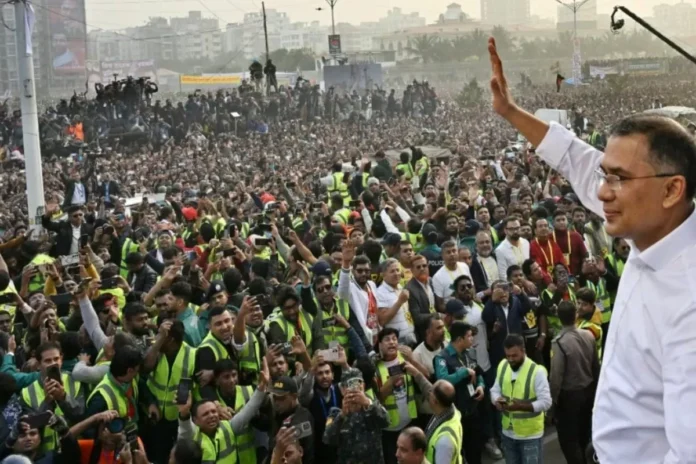
Tarique Rahman, the eldest son of former Bangladesh Prime Minister Khaleda Zia, has returned to his home country after 17 long years of exile in London. His arrival has sparked a wave of excitement and anticipation among the political circles, as he is set to be at the centre of power after his party’s victory in the recent elections.
Rahman, who is the Vice Chairman of the Bangladesh Nationalist Party (BNP), left the country in 2008 after being charged with corruption and money laundering. He chose to stay in the United Kingdom, where he was granted asylum and lived a quiet life away from the chaos and turmoil of Bangladesh’s politics.
However, after years of living in exile, Rahman decided to take a bold step and return to his homeland. His return has been hailed as a significant moment in Bangladesh’s political landscape and has been met with mixed reactions.
While many see his return as a threat to the ruling party, others view it as a ray of hope for the opposition and the country’s democracy. Rahman’s return has once again brought the BNP to the forefront of the political scene, and his party’s victory in the recent elections has further solidified his position as a key player in Bangladesh’s politics.
The BNP, under the leadership of Khaleda Zia, has been the country’s main opposition party for decades. However, with Zia currently serving a prison sentence on corruption charges, Rahman’s return has given a new boost to the party’s morale and has brought a much-needed injection of energy and enthusiasm.
Rahman’s return has been welcomed by his party members and supporters, who see him as the rightful heir to the BNP’s leadership. His charisma and strong leadership skills have always been admired by his followers, and his return has given them a renewed sense of hope and determination.
Moreover, Rahman’s return has also been seen as a positive development for the country’s political stability. In the past few years, Bangladesh’s political scene has been marred by violence and unrest, with the ruling party and the opposition at loggerheads with each other.
With Rahman’s return, there is hope that the political climate in the country will improve and that the ruling party and the opposition will be able to work together for the betterment of Bangladesh.
Despite his long absence from the country, Rahman’s popularity among the people has not waned. His supporters see him as a charismatic leader who has the ability to bring about positive changes in the country.
Rahman’s return has also been welcomed by the international community, who see it as a positive step towards strengthening democracy in Bangladesh. The United States, in a statement, has expressed its hope that Rahman’s return will lead to a peaceful and inclusive political environment in the country.
However, Rahman’s return has also been met with criticism from some quarters. Some have accused him of fleeing the country to avoid facing corruption charges and have called for him to be brought to justice. However, Rahman has denied these allegations and has stated that he returned to Bangladesh with the intention of serving his country and its people.
As Rahman prepares to take on a more prominent role in the country’s politics, he faces many challenges ahead. The BNP, under his leadership, will have to work towards regaining the trust of the people and present a strong and united front against the ruling party.
Moreover, Rahman will also have to prove his critics wrong and show that he is committed to bringing about positive changes in the country. His actions and decisions in the coming months will be closely scrutinized, and the people of Bangladesh will be looking to him for leadership and guidance.
In conclusion, Rahman’s return to Bangladesh after 17 years of exile has been a significant event in the country’s political history. It has given a new lease of life to the opposition and has brought hope for a more stable and peaceful political environment in the country. As he takes on a more prominent role in the country’s politics, Rahman has the opportunity to make a positive impact and bring about much-needed change for the betterment of Bangladesh and its people.