
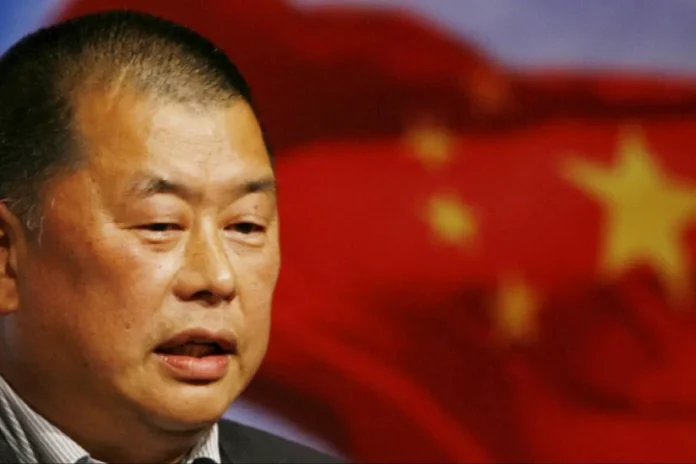
Jimmy Lai, a prominent media tycoon and vocal critic of Beijing, has been sentenced to 20 years in prison under Hong Kong’s controversial national security law. This harsh sentence is seen as a symbol of the Chinese government’s crackdown on press freedoms and dissent in the city, following the pro-democracy protests in 2019.
Lai, the founder of Next Digital media group and the owner of the popular pro-democracy newspaper Apple Daily, has long been a thorn in the side of the Chinese Communist Party (CCP). He has been a vocal advocate for democracy and human rights in Hong Kong, and has used his media outlets to expose the government’s abuses and corruption.
However, Lai’s outspokenness and criticism of Beijing have made him a target of the Chinese government’s crackdown on dissent in Hong Kong. In August 2020, he was arrested under the national security law, which was imposed by Beijing in June of that year. The law criminalizes acts of secession, subversion, terrorism, and collusion with foreign forces, and carries a maximum sentence of life imprisonment.
Lai’s trial, which began in December 2020, was closely watched by the international community as a test of the national security law’s impact on press freedom in Hong Kong. The prosecution accused Lai of colluding with foreign forces by calling for sanctions against China and Hong Kong, and of using his media outlets to incite others to participate in the pro-democracy protests.
Despite the lack of concrete evidence, Lai was found guilty and sentenced to 20 years in prison on Friday, April 16th. The sentence is one of the longest given under the national security law and has been widely condemned by human rights groups and press freedom advocates.
The sentencing of Jimmy Lai is a clear indication of the Chinese government’s determination to silence dissent and control the media in Hong Kong. It is a blatant violation of the city’s promised autonomy and the freedom of speech and press guaranteed under the Basic Law, Hong Kong’s mini-constitution.
The national security law has been used as a tool to suppress any form of opposition to the Chinese government’s rule in Hong Kong. Since its implementation, dozens of pro-democracy activists, journalists, and politicians have been arrested, and media outlets have been raided and censored. This has created a climate of fear and self-censorship, leading to a significant decline in press freedom in the city.
The sentencing of Jimmy Lai has sparked outrage and condemnation from the international community. The United States, the European Union, and the United Kingdom have all expressed their concerns and called for Lai’s immediate release. The United Nations High Commissioner for Human Rights, Michelle Bachelet, has also called for the national security law to be revised to ensure it complies with international human rights standards.
The imprisonment of Jimmy Lai is a grave injustice and a blow to press freedom in Hong Kong. It sends a chilling message to journalists and media outlets that they must toe the line and refrain from criticizing the Chinese government if they want to avoid a similar fate.
However, despite this setback, the fight for press freedom and democracy in Hong Kong is far from over. Lai’s unwavering commitment to these values has inspired many, and his imprisonment has only strengthened their resolve to continue the struggle.
In the face of adversity, the people of Hong Kong have shown incredible resilience and determination. The 2019 protests, which saw millions take to the streets to demand democracy and freedom, were a testament to their unwavering spirit. And even now, as the city faces increasing repression, the people of Hong Kong continue to find ways to express their dissent and fight for their rights.
The sentencing of Jimmy Lai may be a dark moment for press freedom in Hong Kong, but it also serves as a reminder of the importance of a free and independent media in a democratic society. Lai’s media outlets have played a crucial role in holding the government accountable and providing a platform for diverse voices to be heard. Their continued existence and resilience in the face of government pressure is a testament to the power of a free press.
In conclusion, the sentencing of Jimmy Lai to 20 years in prison is a grave injustice and a clear violation of press freedom in Hong Kong. It is a symbol of the Chinese government’s determination to silence dissent and control the media in the city. However, it also serves as a reminder of the resilience and determination of the