
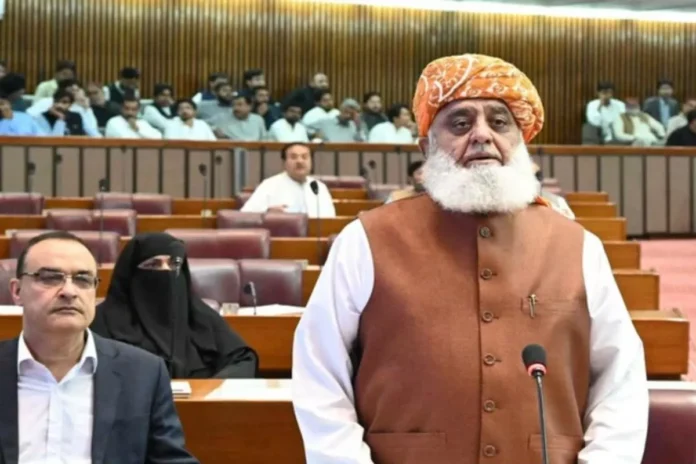
Fazlur Rehman, the renowned Pakistani scholar and political leader, has recently raised some important questions about Pakistan’s strategic thinking over the past 78 years. In particular, he has scrutinized the way Pakistan has handled its relationship with Afghanistan. His remarks have sparked a debate in the country, as well as outside of it, about the approach that Pakistan should take in fulfilling its national interests.
Rehman’s concerns are rooted in the long-standing and complex relationship between Pakistan and Afghanistan. The two neighboring countries share deep historical, cultural, and economic ties. However, their relationship has been fraught with challenges, including border disputes, refugee influx, and accusations of cross-border terrorism. Despite these complexities, Pakistan has always considered Afghanistan as an important ally in the region. But according to Rehman, Pakistan’s strategic thinking has not always reflected this sentiment.
Rehman, in his criticism, has highlighted some key issues that he believes have hindered Pakistan’s ability to effectively manage its relationship with Afghanistan. He has pointed out that Pakistan’s foreign policy towards Afghanistan has been inconsistent and reactive, lacking a long-term vision and strategy. This has resulted in a lack of trust between the two countries and has allowed external forces to exploit the situation for their own agendas.
One of the major issues that Rehman has identified is the failure of Pakistan’s successive governments to establish a stable and friendly government in Afghanistan. He argues that instead of supporting an inclusive and representative government in Afghanistan, Pakistan has meddled in its internal affairs and backed certain factions, which has only fueled the ongoing conflict in the country. This approach has not only strained the relationship between the two countries but has also damaged Pakistan’s image on the international stage.
Moreover, Rehman has also questioned Pakistan’s reliance on the military to manage its relationship with Afghanistan. He believes that Pakistan’s military-centric approach has not only failed to achieve its intended objectives but has also isolated the country from the international community. This has led to an over-reliance on China, which has its own strategic interests in the region and is not a long-term solution for Pakistan.
Another important aspect that Rehman has highlighted is the lack of economic cooperation between Pakistan and Afghanistan. He has emphasized the need for trade and economic ties between the two countries, which would not only boost their economies but also improve their relationship. Despite being blessed with abundant natural resources, Afghanistan remains one of the poorest countries in the world. Pakistan, on the other hand, has the potential to become a regional economic powerhouse. By strengthening economic ties, both countries can benefit and foster a mutually beneficial relationship.
In light of these issues, Rehman has called for a new and comprehensive approach towards Afghanistan. He believes that Pakistan’s strategic thinking needs to shift from short-term gains to long-term goals. This includes prioritizing peace and stability in Afghanistan, supporting an inclusive government, and promoting economic cooperation. He has also stressed the need for Pakistan to have an honest and open dialogue with Afghanistan, based on mutual respect and understanding.
Rehman’s criticism has sparked a much-needed debate in Pakistan about its relationship with Afghanistan. It has also highlighted the importance of re-evaluating and restructuring Pakistan’s foreign policy towards its neighbor. In response to Rehman’s remarks, the Pakistani government has emphasized its commitment to peaceful relations with Afghanistan and has expressed its willingness to work towards resolving the ongoing conflict in the country. This is a positive step in the right direction and shows that Pakistan is open to constructive criticism and willing to learn from its past mistakes.
In conclusion, Fazlur Rehman’s questioning of Pakistan’s strategic thinking towards Afghanistan is a timely reminder to re-evaluate and reassess our approach towards our neighbor. It is a call to shift from reactive policies to proactive strategies that focus on long-term peace, stability, and economic cooperation. Pakistan and Afghanistan share a unique bond, and it is in the best interest of both countries to work towards building a strong and prosperous region. By learning from the past and adopting a more collaborative approach, we can build a better future for ourselves and for our neighbors. As Rehman rightly points out, it is time for Pakistan to take charge of its strategic thinking and forge a new path towards a peaceful and stable South Asia.