
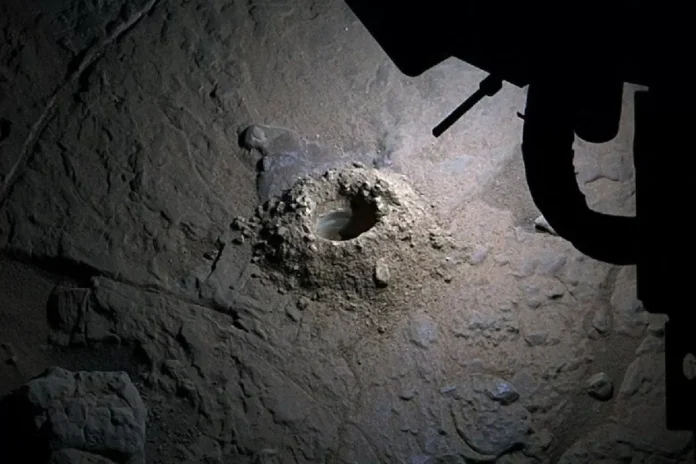
NASA’s Curiosity has once again proved its versatility by turning its robotic arm into a portable lamp to capture stunning photographs of the Red Planet under pitch-black skies. This groundbreaking feat by the Mars rover is a major step in its mission to explore the Martian surface and provide valuable insights about our neighboring planet.
On October 27, 2021, Curiosity used its Mast Camera, or Mastcam, to take a series of photos of itself and its surroundings. But what made these photos truly remarkable was the fact that they were taken under the dark night sky of Mars. This is the first time that Curiosity has used its robotic arm as a light source for photography, making it a truly pioneering achievement.
The Curiosity rover, which has been roaming the Martian surface since 2012, has previously relied on natural light to capture images of the Red Planet. But due to the shorter daylight hours and dust storms that often obscure the sun, it has not been possible to take pictures during the night. This has limited the rover’s activities and the amount of data it can collect.
However, NASA’s engineers came up with a brilliant solution to this problem. They programmed the rover’s robotic arm to act as a light source, essentially turning it into a portable lamp. The arm’s LED lights were used to illuminate the rover and its surroundings, allowing the Mastcam to take clear and detailed photos even in the dark.
This development has opened up a whole new world of possibilities for Curiosity. With the ability to take photos at night, the rover can now continue its scientific investigations 24 hours a day, greatly increasing the amount of data it can collect. This is crucial for NASA’s mission to understand the geological and environmental conditions on Mars, and to search for any evidence of past or present life on the planet.
But the use of the robotic arm as a light source is not just limited to photography. It can also be used to study the chemical composition of rocks and minerals on Mars, which will provide valuable insights into the planet’s history and evolution. This is an exciting new development that will greatly enhance Curiosity’s capabilities and further our understanding of Mars.
This achievement is a testament to the ingenuity and innovation of NASA’s engineers and scientists. They have once again pushed the boundaries of what is possible and found a creative solution to a complex problem. It is a true reflection of the agency’s commitment to exploring the unknown and pushing the limits of space exploration.
The photos taken by Curiosity under the dark Martian sky are awe-inspiring. They not only showcase the rover’s capabilities, but also the breathtaking beauty of the Red Planet. The rocky terrain, the dusty sky, and the distant hills make for a stunning backdrop, highlighting the vastness and mystery of Mars.
The Mars rover’s use of its robotic arm as a light source has captured the attention and imagination of people all around the world. It has sparked discussions and debates among scientists and space enthusiasts, and has once again put NASA and its missions in the spotlight.
So, what’s next for Curiosity? With its newly acquired ability to take photos at night, the rover will continue its journey of discovery on the Martian surface. It will delve deeper into the mysteries of the Red Planet, and hopefully shed more light on its past and present. Who knows what other groundbreaking feats Curiosity will achieve in the future?
In conclusion, NASA’s Curiosity rover has yet again proven why it is the most advanced and capable machine ever sent to Mars. Its use of its robotic arm as a portable lamp for photography is a major milestone in its mission and a remarkable achievement in the history of space exploration. This development will greatly enhance its capabilities and pave the way for future missions to Mars. We eagerly await the next discoveries and breathtaking photos from Curiosity as it continues its journey on the Red Planet.