
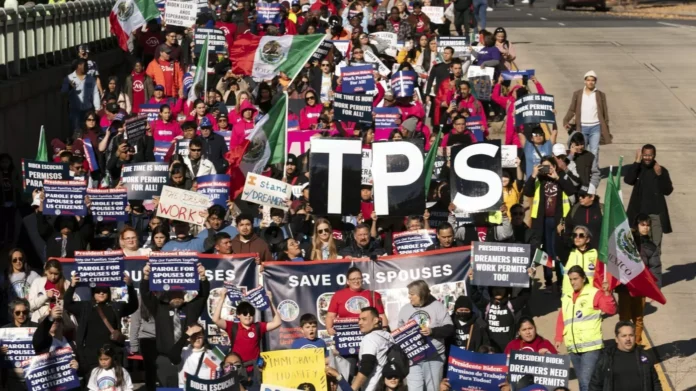
In a significant victory for the Haitian community in the United States, a federal judge has blocked the Trump administration’s attempt to revoke temporary protected status (TPS) for hundreds of thousands of Haitians. On Monday, District Judge Ana Reyes implemented a stay on Homeland Security Secretary Kristi Noem’s order to end TPS for Haitians in the U.S., which was set to go into effect on Tuesday. This decision provides a much-needed reprieve for the Haitian community and their families, who were facing the possibility of deportation and separation.
The temporary protected status program was created to provide a safe haven for individuals from countries that are experiencing ongoing armed conflict, environmental disasters, or other extraordinary and temporary conditions. Haiti was granted TPS in 2010 after a devastating earthquake struck the country, leaving thousands dead and millions displaced. Since then, the program has been renewed several times, allowing Haitians to remain in the U.S. and rebuild their lives.
However, in November 2017, the Trump administration announced its decision to end TPS for Haitians, giving them until July 2019 to either leave the country or face deportation. This decision was met with widespread criticism and sparked fear and uncertainty among the Haitian community and their loved ones. Many argued that Haiti was still struggling to recover from the earthquake and was not equipped to handle the return of thousands of individuals.
In response, a group of Haitian immigrants and their children, who are U.S. citizens, filed a lawsuit against the government, challenging the decision to end TPS. They argued that the Trump administration’s move was racially motivated and violated their constitutional rights. District Judge Ana Reyes agreed with their arguments and granted a stay on the order, postponing its implementation until the case is fully heard.
This decision is a significant victory for the Haitian community and their families, who have been living in limbo for the past few months. It provides them with a sense of relief and hope for a better future. As Judge Reyes stated in her ruling, the government’s decision to end TPS for Haitians was based on “racially discriminatory animus.” This ruling sends a strong message that such discriminatory actions will not be tolerated in the United States.
The decision to block the revocation of TPS for Haitians also highlights the vital role of the judiciary in upholding the values of fairness and justice. In the face of the Trump administration’s anti-immigrant policies, the courts have been a crucial check on executive power. This ruling is a reminder that the U.S. is a nation built on the principles of equality and compassion, and that no one should be targeted based on their race or nationality.
The Haitian community has been an integral part of the fabric of American society for decades. They have contributed to the country’s economy, culture, and diversity, and have become an essential part of many communities. The decision to end TPS for Haitians would have had devastating consequences, not just for the individuals directly affected, but also for their families and the communities they call home.
The stay on the revocation of TPS for Haitians is a temporary relief, but it is a step in the right direction. It gives the Haitian community and their families more time to fight for their rights and make their case in court. It also provides an opportunity for the government to reconsider its decision and find a permanent solution for the thousands of Haitians who have made the U.S. their home.
In conclusion, the federal judge’s decision to block the revocation of TPS for Haitians is a victory for justice and humanity. It sends a powerful message that the U.S. will not tolerate discriminatory actions and will stand up for the rights of all individuals, regardless of their race or nationality. This ruling also serves as a reminder that the American dream is still alive and that the country remains a beacon of hope for those seeking a better life. Let us hope that this decision will pave the way for a more compassionate and fair immigration policy in the future.