
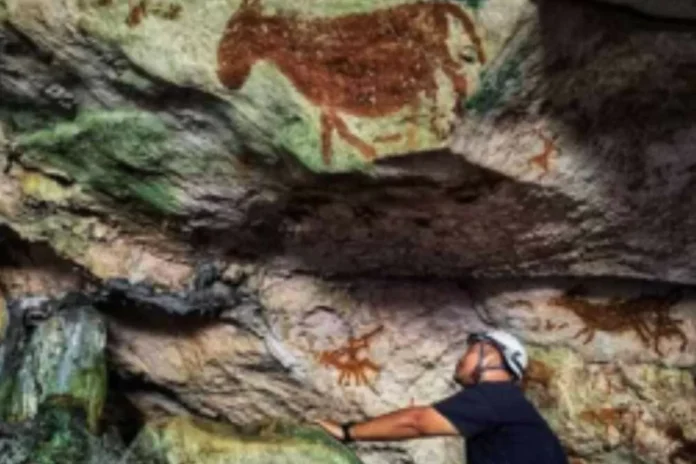
A Red Hand Stencil in Indonesian Cave Reveals Early Human Migration and Unique Sulawesi Painting Styles
Archaeologists have made a groundbreaking discovery in a cave on Muna island, Indonesia. A red hand stencil found in the cave has been dated to be 67,800 years old, making it the oldest known rock art. This finding not only sheds light on the early human migration but also reveals the unique painting styles of the Sulawesi region.
The cave on Muna island, located in the eastern part of Indonesia, has been a site of interest for researchers for many years. However, it was not until recently that a team of archaeologists from Griffith University in Australia made this significant discovery. The team, led by Dr. Maxime Aubert, used a new technique called uranium-series dating to determine the age of the hand stencil, which was previously thought to be around 40,000 years old.
The hand stencil, measuring around 20 by 16 centimeters, was made by blowing red pigment onto the cave wall, leaving a negative impression of the hand. This technique of stenciling is common in rock art, but what makes this particular find unique is the use of a mineral called manganese. This mineral is not commonly used in rock art and suggests a distinct painting style unique to the Sulawesi region.
This discovery is not only a testament to the creativity and artistry of our early human ancestors but also provides valuable insights into their migration patterns. The hand stencil is believed to have been made by a group of hunter-gatherers who traveled through the Southeast Asian islands, eventually reaching Indonesia. This supports the theory that humans migrated to Australia and the Pacific Islands via this route rather than through the landmass of Asia.
Further studies of the cave have revealed more paintings and hand stencils, some of which are dated to be around 40,000 years old. This suggests that the cave was used as an important site for rock art over thousands of years. The team also found evidence that the paintings were made using different techniques, such as finger fluting and dabbing, further proving the unique painting styles of the Sulawesi region.
This discovery has sparked excitement and curiosity among the archaeological community, as it challenges previous beliefs about the origin of rock art and human migration. It also highlights the importance of Southeast Asia in shaping the early human history and culture. The hand stencil in Muna island is now considered to be the oldest example of figurative art in the world, surpassing the previously believed oldest rock art found in Europe, which dates back to around 40,000 years.
The find also adds to the growing evidence that rock art was an integral part of our early ancestors’ lives, serving as a means of communication, expression, and storytelling. The red hand stencil, in particular, is a powerful symbol of the human connection to the land and the environment. The use of red pigment, which is commonly associated with blood and life, suggests a deep understanding and reverence for nature by these early humans.
The discovery of the red hand stencil in the Indonesian cave on Muna island is a significant milestone in understanding our human origins and the evolution of art. It also emphasizes the importance of preserving and studying rock art sites, which are valuable time capsules of our past. This finding will undoubtedly lead to more research and exploration in the Sulawesi region, and we can expect more exciting discoveries in the future.
In conclusion, the red hand stencil found in the Indonesian cave on Muna island is a remarkable discovery that not only reveals the early human migration but also showcases the unique painting styles of the Sulawesi region. This finding challenges previous beliefs and adds new dimensions to our understanding of human history and culture. It is a reminder of the ingenuity and creativity of our ancestors and their deep connection with the environment. The red hand stencil is a symbol of our shared human heritage and a testament to the enduring power of art.