
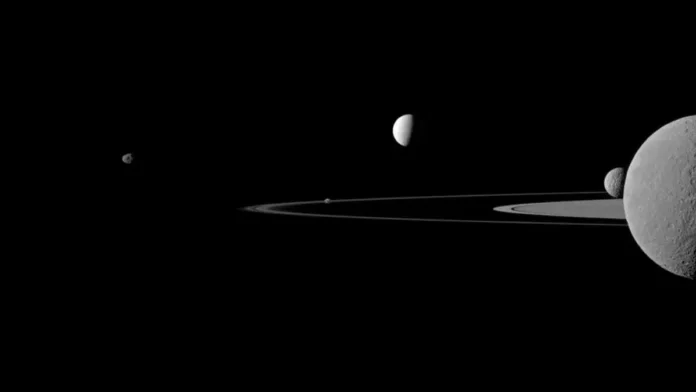
Enceladus is a small, icy moon of Saturn that has captured the attention of scientists and space enthusiasts alike. With its intriguing features and potential for habitability, it has become a prime target for exploration and the search for extraterrestrial life. In fact, many experts believe that Enceladus should be ranked at the top of the list for future space missions, as it holds the key to unlocking some of the biggest mysteries of our universe.
One of the main reasons why Enceladus is such an exciting target for exploration is its subsurface ocean. This vast body of water, which is estimated to be as large as the Great Lakes of North America, is believed to be in contact with a rocky core, creating the perfect conditions for potential life to thrive. The discovery of this ocean was made in 2005 by NASA’s Cassini spacecraft, which also detected plumes of water vapor and organic compounds erupting from the moon’s surface.
The presence of liquid water on Enceladus is a crucial factor in the search for habitability and life. Water is essential for all known forms of life, and the fact that it exists in liquid form on this distant moon is a promising sign. Furthermore, the organic compounds found in the plumes suggest that there may be complex chemical reactions taking place in the ocean, which could potentially support microbial life.
But it’s not just the subsurface ocean that makes Enceladus an attractive target for exploration. The moon’s surface is also full of fascinating features that could provide valuable insights into its past and present. One of the most striking features is the “tiger stripes,” which are long, linear fractures in the moon’s icy crust. These fractures are thought to be the source of the plumes and may also provide access to the subsurface ocean.
In addition to the tiger stripes, Enceladus also boasts a diverse landscape of mountains, valleys, and craters. These features suggest that the moon has a dynamic geology, with ongoing processes such as tectonic activity and cryovolcanism shaping its surface. By studying these processes, scientists can gain a better understanding of how Enceladus formed and evolved over time, and whether it has the potential to support life.
Furthermore, Enceladus is relatively close to Earth compared to other potential targets for exploration, such as Jupiter’s moon Europa. This proximity makes it easier and more cost-effective to send spacecraft to Enceladus and gather data. In fact, NASA’s Cassini mission has already provided us with a wealth of information about the moon, but there is still so much more to discover.
So why should Enceladus be ranked as the top target for exploration and the search for life? The answer is simple – it has all the necessary ingredients for habitability. Liquid water, organic compounds, and a dynamic geology make it a prime candidate for hosting life, even if it is in microbial form. By studying Enceladus, we could potentially answer one of the most profound questions in science – are we alone in the universe?
But the search for life on Enceladus is not just about satisfying our curiosity. It could also have significant implications for our understanding of the origins of life on Earth. If we find evidence of life on this distant moon, it would suggest that the building blocks of life are not unique to our planet and could potentially exist elsewhere in the universe. This would have profound implications for our understanding of the origins and prevalence of life in the cosmos.
Of course, exploring Enceladus and searching for life will not be an easy task. It will require a significant investment of resources and technology, as well as international collaboration. However, the potential rewards far outweigh the challenges. The knowledge and discoveries we could gain from studying Enceladus could revolutionize our understanding of the universe and our place within it.
In conclusion, Enceladus is a small moon with a big potential. Its subsurface ocean, dynamic geology, and proximity to Earth make it the prime target for exploration and the search for life. By studying this distant world, we could unlock some of the biggest mysteries of our universe and potentially answer the age-old question of whether we are alone in the cosmos. It is time to prioritize the exploration of Enceladus and take the next steps towards uncovering its secrets.