
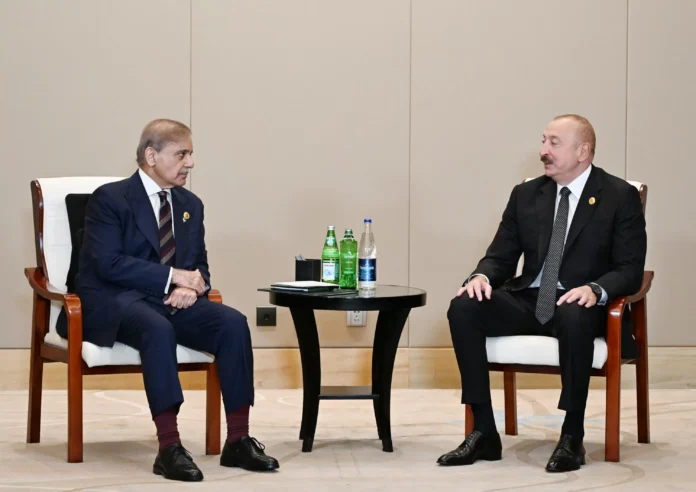
On Monday, Azerbaijan’s President Ilham Aliyev accused India of seeking “revenge” against his country in global forums. The President’s comments came as a surprise to many, as Azerbaijan and India have traditionally enjoyed friendly relations. The accusations were made during a meeting with foreign media representatives, where Aliyev expressed his concerns about India’s recent actions.
The root of this controversy lies in Azerbaijan’s close ties with Pakistan. Aliyev believes that India is using international platforms to punish Azerbaijan for its strong alliance with Pakistan. He stated, “India sees Pakistan as its biggest enemy and is constantly trying to isolate and harm it. In this pursuit, they are now targeting Azerbaijan, which only strengthens our relationship with Pakistan.”
This statement raises many eyebrows, as it is an unexpected and uncharacteristic move from a leader known for his diplomatic rhetoric. The President also accused India of interfering in Azerbaijan’s internal affairs, stating that “India has been trying to influence our domestic policies and even raise issues that have no relevance to their bilateral relations with us.”
Aliyev’s remarks have created a stir in both Azerbaijan and India. While the Indian government has refrained from making any immediate comments, the people of Azerbaijan have expressed their disappointment and confusion. Many in the country have questioned the timing and necessity of these accusations, especially considering India and Azerbaijan’s long-standing friendly relations.
The two nations have enjoyed strong ties for decades, rooted in shared cultural and historical similarities. India was one of the first countries to recognize Azerbaijan’s independence in 1991 and was one of the first to establish diplomatic relations. Since then, the two countries have cooperated in multiple areas, including trade, defense, and cultural exchanges.
However, in recent years, there has been a noticeable shift in India’s approach towards Azerbaijan. While India continues to engage with Azerbaijan on various fronts, it has also established closer ties with Azerbaijan’s neighbors, including Armenia. This has caused some unease in Azerbaijan, especially given the ongoing conflict between Azerbaijan and Armenia over the Nagorno-Karabakh region.
In light of these developments, Aliyev’s accusations can be seen as a warning to India to not take their relationship for granted. As Azerbaijan’s President, Aliyev is responsible for safeguarding his country’s interests and ensuring its security. Therefore, it is natural for him to express concerns over any actions that could potentially harm Azerbaijan’s relationship with its allies.
However, it is also essential to view the situation objectively and examine both sides of the story. India has consistently maintained a neutral stance on the Nagorno-Karabakh conflict and has not taken any actions that could be interpreted as harmful to Azerbaijan. India’s ties with Pakistan should not affect its relations with other countries, and it is crucial to respect each country’s sovereignty and independence.
Moreover, India has invested significantly in Azerbaijan’s infrastructure development, including the construction of the Baku-Tbilisi-Kars railway line, which has enhanced regional connectivity and boosted trade. India has also allowed visa-free travel for Azerbaijani citizens, further facilitating people-to-people exchanges. These actions demonstrate India’s commitment to its friendship with Azerbaijan.
In conclusion, while President Aliyev’s remarks may have caused some friction, it is crucial for both countries to continue their cooperation and maintain their friendly ties. Azerbaijan and India have much to gain from each other, and it is in their best interest to work together for the betterment of their people. Accusations and suspicion will only harm the progress made so far and hinder future cooperation. It is essential to address any concerns through dialogue and find amicable solutions. As allies and friends, Azerbaijan and India can overcome any challenges and continue to strengthen their relationship for mutual benefit and prosperity.

