
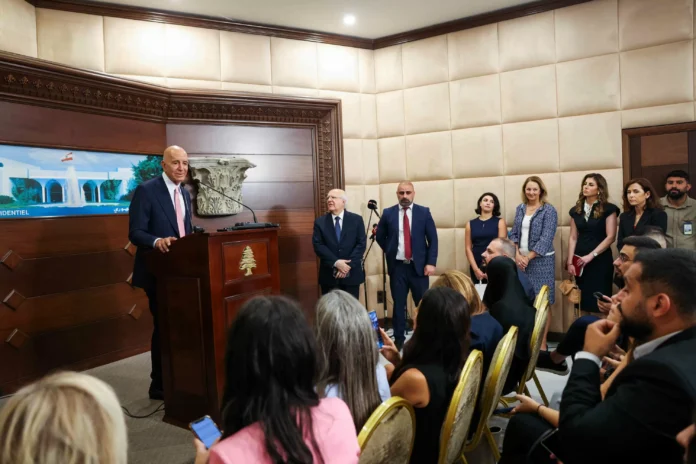
U.S. envoy to Syria Tom Barrack sparked controversy in Lebanon on Tuesday after making derogatory comments about journalists during a press conference at the Presidential Palace in Baabda. The American businessman, who was appointed as the Special Envoy for Syria by President Donald Trump in 2017, referred to the behavior of journalists as “animalistic”, causing an uproar among media professionals and human rights activists.
Barrack’s comments came in response to a question about the ongoing protests in Lebanon and the role of the media in covering them. He stated, “The behavior of journalists in Lebanon is animalistic. They are not reporting the news, they are making the news. They are not objective, they are subjective. They are not journalists, they are activists.” These remarks have been met with widespread condemnation and have been described as insulting and disrespectful towards the press.
The U.S. envoy’s comments have been seen as an attack on the freedom of the press, a fundamental principle of democracy. Lebanon has a long history of press freedom and a vibrant media landscape, with over 100 newspapers, magazines, and news websites. Journalists in the country have been at the forefront of covering the ongoing protests, which have been calling for an end to corruption and government mismanagement.
The Lebanese Press Syndicate, a union representing journalists, issued a statement condemning Barrack’s remarks and demanding an apology. They stated, “The Press Syndicate considers these statements as a flagrant violation of the freedom of the press and an insult to the honorable profession of journalism.” The syndicate also called on the Lebanese government to take a stand against such attacks on the media.
Human rights organizations have also spoken out against Barrack’s comments, with Amnesty International calling them “deeply troubling” and a “disregard for the role of the media in a democratic society.” The organization also urged the U.S. envoy to retract his statements and show respect for the work of journalists in Lebanon.
Barrack’s comments have caused a stir on social media, with many journalists and activists using the hashtag #JournalismIsNotAnimalistic to express their outrage. They have also shared stories and examples of the important role that the media has played in covering the protests and holding the government accountable.
In response to the backlash, the U.S. Embassy in Lebanon released a statement clarifying Barrack’s comments. They stated, “The U.S. Embassy in Lebanon values the freedom of the press and recognizes the important role that journalists play in a democratic society. The Special Envoy’s comments were not meant to insult or belittle the media, but rather to express his frustration with the lack of objectivity and professionalism in some reporting.”
While the U.S. Embassy has attempted to downplay the controversy, Barrack’s comments have shed light on the challenges faced by journalists in Lebanon. In recent years, there have been numerous attacks on the media, including physical assaults and death threats, which have created a climate of fear and self-censorship. The U.S. envoy’s remarks have only added to the concerns of media professionals who are already struggling to do their jobs in a hostile environment.
It is important to note that the role of journalists is crucial in any society, especially in times of political and social upheaval. They are the watchdogs of democracy, holding those in power accountable and providing the public with accurate and unbiased information. The media in Lebanon has played a vital role in covering the ongoing protests, and their work should be respected and protected, not ridiculed.
In conclusion, the U.S. envoy’s comments have caused a storm of criticism in Lebanon, highlighting the challenges faced by journalists in the country. It is important for all parties to respect the role of the media and work towards creating a safe and conducive environment for journalists to do their jobs without fear of reprisals. The freedom of the press is a cornerstone of democracy and must be protected at all costs.

