
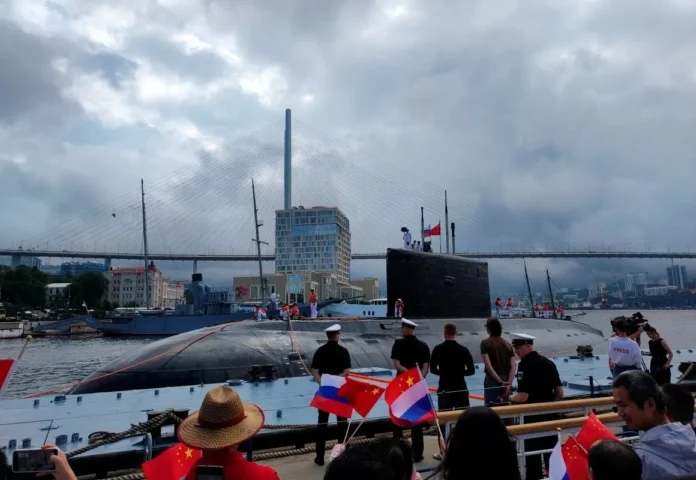
China and Russia, two major world powers, have once again come together to strengthen their partnership and showcase their united front against the U.S.-led global order. On Sunday, the two countries launched joint naval drills in the Sea of Japan, sending a clear message to the world that they are ready to counter any threats to their sovereignty and security.
The joint naval drills, codenamed “Joint Sea-2019”, involved over 10 ships from both countries, including guided-missile destroyers, frigates, and support vessels. The exercises also included joint air defense and anti-submarine warfare training, as well as a simulated joint amphibious assault.
This is not the first time that China and Russia have conducted joint naval drills. In fact, these exercises have become a regular occurrence in recent years, with the two countries holding similar drills in the Baltic Sea, the Mediterranean, and the South China Sea. However, the timing and location of the latest drills hold significant significance.
The Sea of Japan, also known as the East Sea, is a disputed territory between Japan and South Korea. The U.S. has been actively involved in the region, conducting military exercises and maintaining a strong presence with its allies. By conducting joint drills in this area, China and Russia are sending a clear message that they will not tolerate any interference from the U.S. in their backyard.
The timing of the drills is also significant, coming just days after the U.S. announced plans to deploy intermediate-range missiles in Asia, which is seen as a direct challenge to China and Russia’s military capabilities. This move has raised concerns about a possible arms race in the region, and China and Russia’s joint drills can be seen as a response to this threat.
But beyond the strategic and geopolitical implications, these joint naval drills also highlight the deepening partnership between China and Russia. Both countries have been strengthening their ties in recent years, with a shared goal of countering the U.S.-led global order. This partnership has been further solidified by their mutual support in various international forums, including the United Nations.
The economic aspect of this partnership cannot be ignored either. China and Russia have been actively boosting their trade and investment ties, with a goal of reaching $200 billion in trade by 2024. They have also been working together on major infrastructure projects, such as the Belt and Road Initiative and the Eurasian Economic Union, which will further enhance their economic cooperation.
The joint naval drills in the Sea of Japan also serve as a reminder to the U.S. that it cannot continue to dominate the global order unchallenged. China and Russia’s partnership is a clear indication that the world is becoming more multipolar, with different powers rising to challenge the U.S.’s hegemony. This shift in the global power balance has been accelerated by the current U.S. administration’s policies, which have alienated many of its traditional allies.
The joint drills also highlight the growing military capabilities of China and Russia. Both countries have been investing heavily in their armed forces and have been modernizing their equipment. These joint exercises provide an opportunity for the two countries to showcase their military might and test their capabilities in a real-life scenario.
The drills also serve as a confidence-building measure between the two countries. By conducting joint military exercises, China and Russia are building trust and cooperation between their armed forces, which can be crucial in case of any future conflicts.
In conclusion, the joint naval drills in the Sea of Japan by China and Russia are a clear demonstration of their deepening partnership and their determination to counter any threats to their sovereignty and security. This partnership has not only strategic and economic implications but also sends a strong message to the world that the global power balance is shifting. As China and Russia continue to strengthen their ties, the U.S. and its allies will have to reassess their approach towards these two rising powers.