
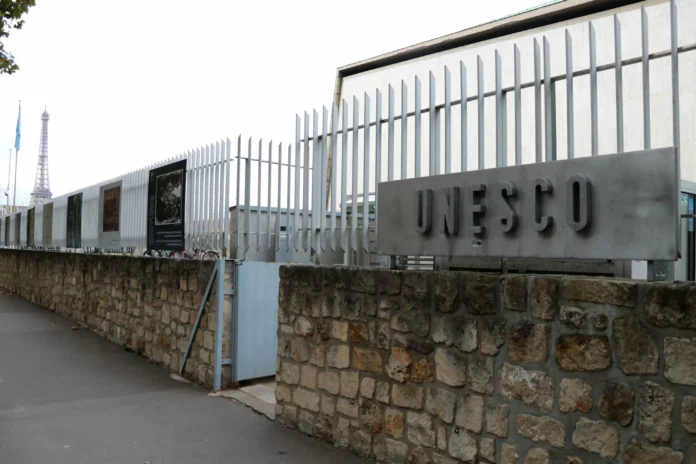
President Donald Trump has once again made a controversial decision, announcing that the United States will be pulling out of the United Nations Educational, Scientific and Cultural Organization (UNESCO). This move comes as a repeat of his first term, where he also withdrew the US from the organization. In his statement, President Trump referred to UNESCO as ‘woke’ and ‘divisive’, citing the need for the US to prioritize its own interests.
UNESCO, founded in 1945, is a specialized agency of the United Nations that promotes international cooperation in education, science, and culture. Its mission is to promote peace and security through educational, scientific, and cultural exchanges. However, President Trump believes that the organization has become too politically correct and has lost sight of its original purpose.
In his statement, President Trump stated, “The United States will not be a part of an organization that constantly puts political correctness above the values and interests of its own people.” He went on to say that UNESCO has become a “tool for those who wish to divide us,” and that it is time for the US to focus on its own priorities.
This decision has sparked mixed reactions, with many expressing disappointment and concern over the US’s withdrawal from UNESCO. However, there are also those who support President Trump’s decision, viewing it as a necessary step to protect the interests of the American people.
One of the main reasons cited for the US’s withdrawal from UNESCO is the organization’s perceived anti-Israel bias. In 2011, the US stopped funding UNESCO after it voted to admit Palestine as a full member. President Trump’s administration has also expressed concerns about the organization’s handling of heritage sites in Jerusalem, which they believe is biased against Israel.
However, the decision to withdraw from UNESCO is not just about Israel. President Trump has also criticized the organization’s management and alleged financial mismanagement. He has accused UNESCO of being inefficient and wasting taxpayer dollars. In 2017, the US Department of State announced that it would be withdrawing from UNESCO due to the organization’s mounting financial arrears and the need for fundamental reform.
President Trump’s decision has been met with criticism from many who see it as a move that will weaken the US’s global influence and undermine its commitment to international cooperation. However, there are also those who support the withdrawal, seeing it as a way to prioritize the US’s own interests and values.
Some have argued that the US’s withdrawal from UNESCO is not just a symbolic move but will also have tangible consequences. The US’s financial contributions to the organization account for 22% of its total budget, and its withdrawal will leave a significant gap in funding for crucial programs and initiatives.
Despite the criticism, President Trump remains firm in his decision, stating that the US will continue to cooperate with UNESCO as a non-member observer state. He also emphasized that the US will continue to support important initiatives such as promoting education for girls and protecting cultural heritage.
The US’s withdrawal from UNESCO is not the first time the country has pulled out of a major international organization. In 2018, the US withdrew from the United Nations Human Rights Council, citing its bias against Israel and its failure to address human rights abuses in other countries. This move, along with the withdrawal from UNESCO, is seen by many as a reflection of President Trump’s “America First” foreign policy.
In conclusion, President Trump’s decision to withdraw the US from UNESCO has once again sparked debate and controversy. While some view it as a necessary step to protect the interests of the American people, others see it as a move that will weaken the US’s global influence and hinder international cooperation. Only time will tell the impact of this decision, but one thing is certain – the US’s relationship with UNESCO will never be the same.