
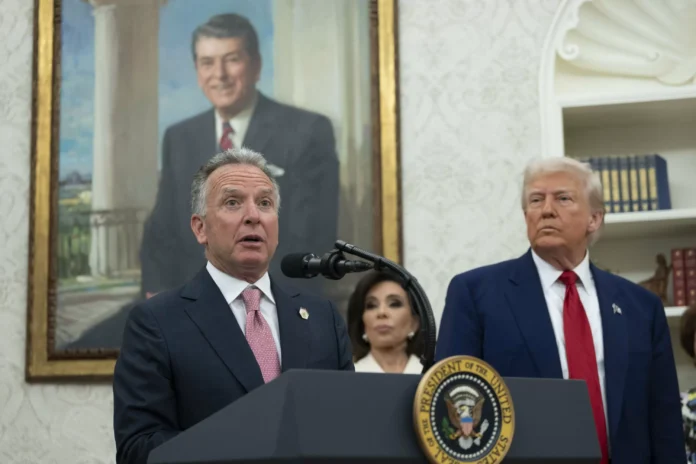
In a recent statement, President Donald Trump’s Middle East envoy Steve Witkoff emphasized that nuclear enrichment and weaponization will continue to be red lines for the United States in any future engagement with Iran. This reaffirms the US’s strong stance against Iran’s nuclear ambitions and highlights the importance of preventing the country from obtaining nuclear weapons.
The issue of Iran’s nuclear program has been a contentious topic for decades, with the US and its allies expressing concerns over the country’s intentions and capabilities. The Joint Comprehensive Plan of Action (JCPOA), commonly known as the Iran nuclear deal, was signed in 2015 with the aim of curbing Iran’s nuclear activities in exchange for sanctions relief. However, the US withdrew from the deal in 2018, citing concerns over its effectiveness and Iran’s continued support for terrorist organizations.
Since then, the US has implemented a maximum pressure campaign on Iran, imposing strict sanctions and taking other measures to prevent the country from developing nuclear weapons. President Trump has repeatedly stated that he will not allow Iran to obtain nuclear weapons, and his administration has made it clear that any future negotiations with Iran must address the issue of nuclear enrichment and weaponization.
In his statement, Witkoff emphasized that the US’s stance on this issue remains unchanged, despite the recent change in administration. He stated, “The United States will not waver in our commitment to preventing Iran from obtaining a nuclear weapon. This is a red line that we will not allow to be crossed.” This strong message serves as a warning to Iran and other countries that may consider pursuing nuclear weapons.
The US’s position on Iran’s nuclear program is not only based on its own national security interests but also on the safety and stability of the entire region. A nuclear-armed Iran would pose a significant threat to its neighbors and could potentially lead to a dangerous arms race in the Middle East. The US is committed to maintaining peace and security in the region and will continue to take necessary measures to prevent any destabilizing actions by Iran.
Witkoff’s statement also serves as a reminder of the importance of the JCPOA’s restrictions on Iran’s nuclear activities. Despite the US’s withdrawal from the deal, the remaining parties, including the European Union, Russia, and China, have continued to uphold their commitments. However, Iran has gradually increased its uranium enrichment levels and violated other restrictions outlined in the deal. This has raised concerns about the country’s true intentions and has further reinforced the US’s stance on the issue.
The US’s strong stance on nuclear enrichment and weaponization is not meant to isolate or punish Iran. Instead, it is a necessary measure to prevent a potentially catastrophic outcome. The US has repeatedly stated its willingness to engage in negotiations with Iran, but any future deal must address the issue of nuclear weapons. This is a non-negotiable red line for the US, and Iran must understand that it cannot be crossed.
In conclusion, President Trump’s Middle East envoy Steve Witkoff’s recent statement reaffirms the US’s strong stance against Iran’s nuclear ambitions. Nuclear enrichment and weaponization will continue to be red lines for the US in any future engagement with Iran. This is not only in the interest of the US but also for the safety and stability of the entire region. The US remains committed to preventing Iran from obtaining nuclear weapons and will take all necessary measures to uphold this red line.