
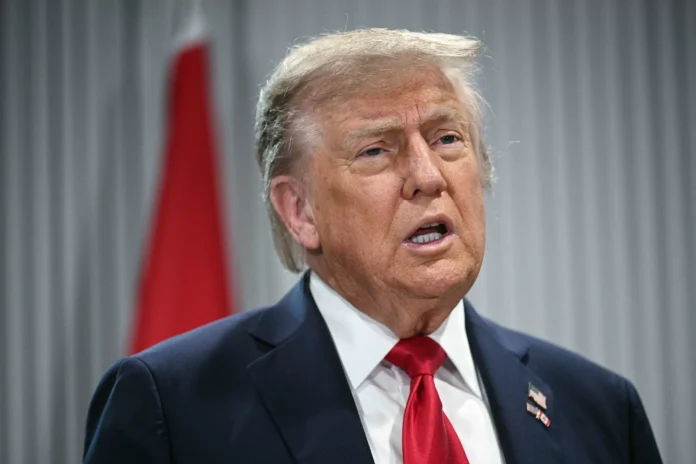
U.S. President Donald Trump made headlines on Monday when he stated that removing Russia from the Group of Eight (G8) was a “mistake” and suggested that China could potentially take its place in the prestigious group. This statement came as a surprise to many, as the G8 has long been seen as a symbol of Western power and unity. However, Trump’s bold statement highlights the shifting global dynamics and the potential for a new world order.
The G8, which consists of the world’s leading industrialized countries, was formed in 1998 with the inclusion of Russia. However, in 2014, after Russia’s annexation of Crimea, the other members of the group decided to suspend Russia’s membership and revert back to the G7. This decision was met with criticism and raised questions about the effectiveness and inclusivity of the group.
In his statement, President Trump acknowledged that removing Russia from the G8 was a “mistake” and that it should be reconsidered. He also suggested that China, the world’s second-largest economy, could potentially take Russia’s place in the group. This suggestion has sparked a debate among political analysts and policymakers, with some seeing it as a strategic move by Trump to strengthen relations with China, while others view it as a threat to the current world order.
Trump’s statement has been met with mixed reactions from the international community. The Russian government has welcomed the idea of rejoining the G8, with Kremlin spokesperson Dmitry Peskov stating that “the G7 format has become obsolete” and that Russia is “ready to be a full member of the G8 again.” However, other G7 members have expressed hesitation about allowing Russia back into the group, citing concerns about Russia’s actions in Ukraine and its interference in other countries’ elections.
The idea of China joining the G8 has also sparked discussions about the country’s role in the international community. China has been rapidly growing both economically and politically, and many experts believe that it is only a matter of time before it becomes a superpower. Including China in the G8 would not only reflect this reality but also provide a platform for the country to play a more active role in global affairs.
Some have raised concerns about the potential consequences of China’s inclusion in the G8. The country’s authoritarian regime and its human rights record have been a source of criticism and opposition. However, others argue that engaging with China in a group like the G8 could lead to positive changes and increased accountability.
President Trump’s statement has also been seen as a reflection of his administration’s efforts to recalibrate the country’s relationship with Russia and China. Trump has been vocal about his desire to improve relations with both countries and has met with their leaders on multiple occasions. By suggesting that they could join the G8, he is sending a signal that the US is open to working with these countries on a global level.
The potential expansion of the G8 to include Russia and China raises important questions about the role and relevance of this group. As the world becomes increasingly interconnected, it is crucial for global leaders to have open and productive dialogue to address pressing issues such as climate change, economic stability, and international security. Including Russia and China in the G8 could provide a platform for such discussions and could lead to more effective solutions.
However, any decision to expand the G8 must be carefully considered and should involve all members of the group. It cannot be a unilateral decision made by the US alone. As President Trump himself stated, “It’s much more appropriate to have Russia in [the G8]. It should be the G8 because a lot of the things we talk about have to do with Russia.” Therefore, any potential expansion should be done with the consensus of all members and should take into account the interests and concerns of all parties involved.
In conclusion, President Trump’s statement about the G8 and the potential inclusion of Russia and China has sparked an important debate about the future of global governance. While some may view it as a controversial move, it is a reflection of the changing dynamics in the international arena. As the world continues to evolve, it is essential for global leaders to adapt and find new ways to work together for the betterment of all nations. The potential expansion of the G8 is a step in that direction, and it is up to the leaders of the world to make the right decisions for a more united and prosperous future.